01
Signal
AHK-Cu
Supports the scalp environment associated with healthier-looking growth and stronger-looking hair at the root.
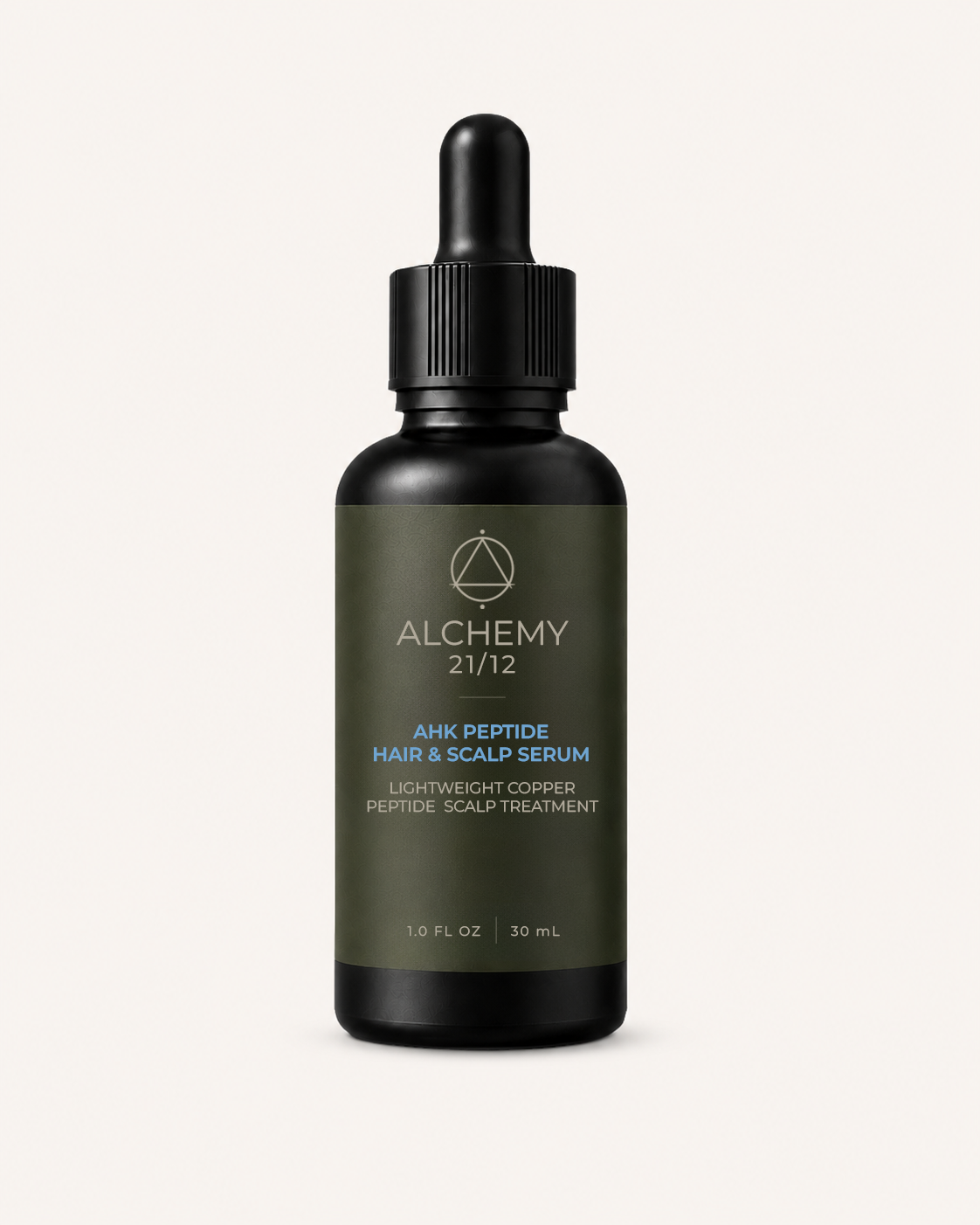


Copper Peptide Scalp Serum for Fuller-Looking Hair
In stock
AHK-Cu is the signal. The formula around it is what makes the signal count.
A lightweight copper peptide scalp serum designed to support fuller-looking hair, stronger-looking roots, and a healthier scalp environment without oil, residue, or hormonal actives.
At 0.25%, AHK-Cu anchors a three-peptide system supported by research in human hair follicles and dermal papilla cells. Acetyl Tetrapeptide-3 supports the structural matrix associated with anchoring hair at the root, while Biotinoyl Tripeptide-1 adds a second follicle-directed peptide for fuller, denser, stronger-looking hair.
L-Histidine is the delivery intelligence. Used in a near-equimolar relationship to copper, it helps coordinate copper and support its handoff within the formula. Sodium PCA, Sodium Lactate, Serine and Glycine form an NMF-based matrix that binds water at the scalp surface, helping create a more favorable diffusion environment for water-soluble actives.
Niacinamide, Panthenol and Allantoin support barrier resilience, helping keep the scalp in condition for consistent daily treatment.
Not a hydrating scalp serum with peptides added. A follicle-directed copper system engineered around signaling, anchoring, copper coordination and delivery.
Designed for daily use without changing your wash schedule.
Water-light. Lipid-free. No oily finish. No sticky root residue.
Biotech treatment for the scalp
Signal. Strengthen. Anchor. Energize.
A water-light copper peptide scalp serum designed to support the follicle environment, strengthen the look of the root, and promote fuller-feeling hair over time.
AHK-Cu
Supports the scalp environment associated with healthier-looking growth and stronger-looking hair at the root.
Acetyl Tetrapeptide-3
Supports the extracellular matrix surrounding the follicle to help hair appear more securely anchored.

Biotinoyl Tripeptide-1
Supports stronger-looking hair and a healthier appearance through the lengths and at the root.
Caffeine + niacinamide
Supports scalp vitality, comfort and the appearance of fuller, more resilient hair over time.
Designed to support the appearance of stronger, fuller and healthier-looking hair with consistent use.
Loved by our Alchemy community

“I lost a lot of hair from losing weight. I started using this product from samples I received roughly 3 months ago, and it has transformed my hairline. I have about an inch and a half of growth all the way around and I am growing new hair across my entire head.” - Tammy
Built around the evidence
A deliberate AHK concentration, a considered copper environment, and a multi-peptide system built around the way the ingredient actually behaves.
We designed ours around the variables we believe matter together: AHK dose, copper chemistry, complementary peptide signaling, scalp support, and a vehicle suitable for consistent leave-in use.
0.25% AHK is not a compromise. It is the design point around which the rest of the formula was built.
We chose 0.25% because the published AHK data give us a clear reason to be deliberate with concentration.
In the foundational human-follicle study, lower experimental concentrations increased follicle elongation. When researchers increased the concentration further, the response did not simply plateau. It reversed.
At the two highest concentrations tested, AHK produced a negative effect on follicle elongation. For us, that makes indiscriminate concentration escalation scientifically difficult to justify.
Positive at lower concentrations. Negative at higher concentrations. That is the dose-response we designed around.
Laboratory molar concentrations and finished topical percentages are not directly interchangeable. That is precisely why we do not pretend there is a magic consumer percentage hidden in the study.
What the study does establish is the direction of the observed response: AHK was stimulatory at lower tested concentrations and inhibitory at higher ones. The dose-response did not merely flatten. It crossed from stimulation to inhibition.
When the published curve can reverse direction, “more” is not a formulation strategy.
Primary research: Pyo HK et al. The effect of tripeptide-copper complex on human hair growth in vitro. Archives of Pharmacal Research. 2007;30(7):834–839. PMID 17703734.
Copper is an essential trace element and a biologically active metal ion. That changes how we formulate.
We do not treat AHK as a number to push upward. We consider the chemical environment surrounding the copper peptide and how that finished system will be used repeatedly on the scalp.
L-Histidine is included deliberately as part of how we manage the copper-peptide environment within the finished formula.
Histidine has an established relationship with copper chemistry and appears throughout foundational peptide-copper literature. We use that chemistry as a formulation principle while keeping the specific coordination strategy proprietary.
Our goal is not maximum copper. It is appropriately managed copper within a formula designed for consistent use.
Anyone can increase the percentage. The harder work is deciding how the copper should behave once it is there.
Formulation reference: foundational peptide-copper patent literature describing histidine-containing peptide-copper systems.
AHK is a copper-binding tripeptide. In AHK Peptide Hair + Scalp Serum, it serves as the central copper peptide within a broader multi-peptide and scalp-support system.
Because 0.25% is the concentration we selected as the best fit for the finished system we wanted to build.
The foundational AHK research shows a concentration-sensitive, non-linear response rather than a simple “more equals more” relationship. Lower experimental concentrations produced a positive effect on follicle elongation. At the two highest tested concentrations, the response reversed and became inhibitory.
0.25% is therefore not a reduced dose. It is the dose around which the rest of the formula was engineered.
No evidence supports treating AHK that way.
In the foundational human-follicle study, increasing AHK beyond the stimulatory range did not create a larger positive response. The response became negative.
That does not mean a finished 1% or 3% topical serum can be directly equated with the inhibitory laboratory concentrations. It does mean that higher concentration alone is not scientifically valid evidence of greater effectiveness.
The study does not provide a direct conversion from laboratory molarity to a finished topical percentage. What it does provide is highly relevant to formulation: the response was positive at lower tested concentrations and negative at higher ones.
That is why we use the study as a guide to concentration discipline rather than as a simplistic recipe for a consumer percentage.
L-Histidine is not included simply as another conditioning amino acid. It was selected deliberately because histidine has an established relationship with copper chemistry and peptide-copper systems.
We consider the chemical environment surrounding AHK to be part of the formulation itself, not an afterthought. The specific coordination approach is proprietary.
Copper is an essential trace element and a biologically active metal ion. That is why our formulation philosophy is purposeful copper use rather than maximum copper use.
We consider concentration, copper chemistry, compatible ingredients, vehicle, and repeat topical use together.
Because the peptides occupy different formulation roles. AHK is the copper-peptide centerpiece, while Acetyl Tetrapeptide-3 and Biotinoyl Tripeptide-1 provide complementary cosmetic hair-support functions.
We prefer a deliberately constructed peptide system over assuming that increasing one ingredient indefinitely improves the finished formula.
No. AHK and GHK are different copper-binding tripeptides with different amino-acid sequences. Alchemy uses them in different products and for different formulation goals.
No. This is a cosmetic peptide scalp serum and contains no minoxidil.
No. The formula contains no hormonal actives and is not formulated as a DHT-blocking drug treatment.
The peptide system is supported by niacinamide, panthenol, caffeine, allantoin, amino acids and NMF-related humectants selected to help maintain a comfortable, well-conditioned scalp environment for consistent leave-in use.
The serum is intentionally water-light and lipid-free. It is designed for direct scalp application with a low-residue finish so daily use does not require changing your normal wash schedule.
Look beyond the largest percentage on the label.
Consider the disclosed concentration, the evidence supporting that concentration story, copper chemistry, complementary peptides, scalp-support ingredients, delivery vehicle, daily-use practicality, hormonal actives, and whether the brand clearly distinguishes finished-product percentage from concentrations used in laboratory research.


Visible density.
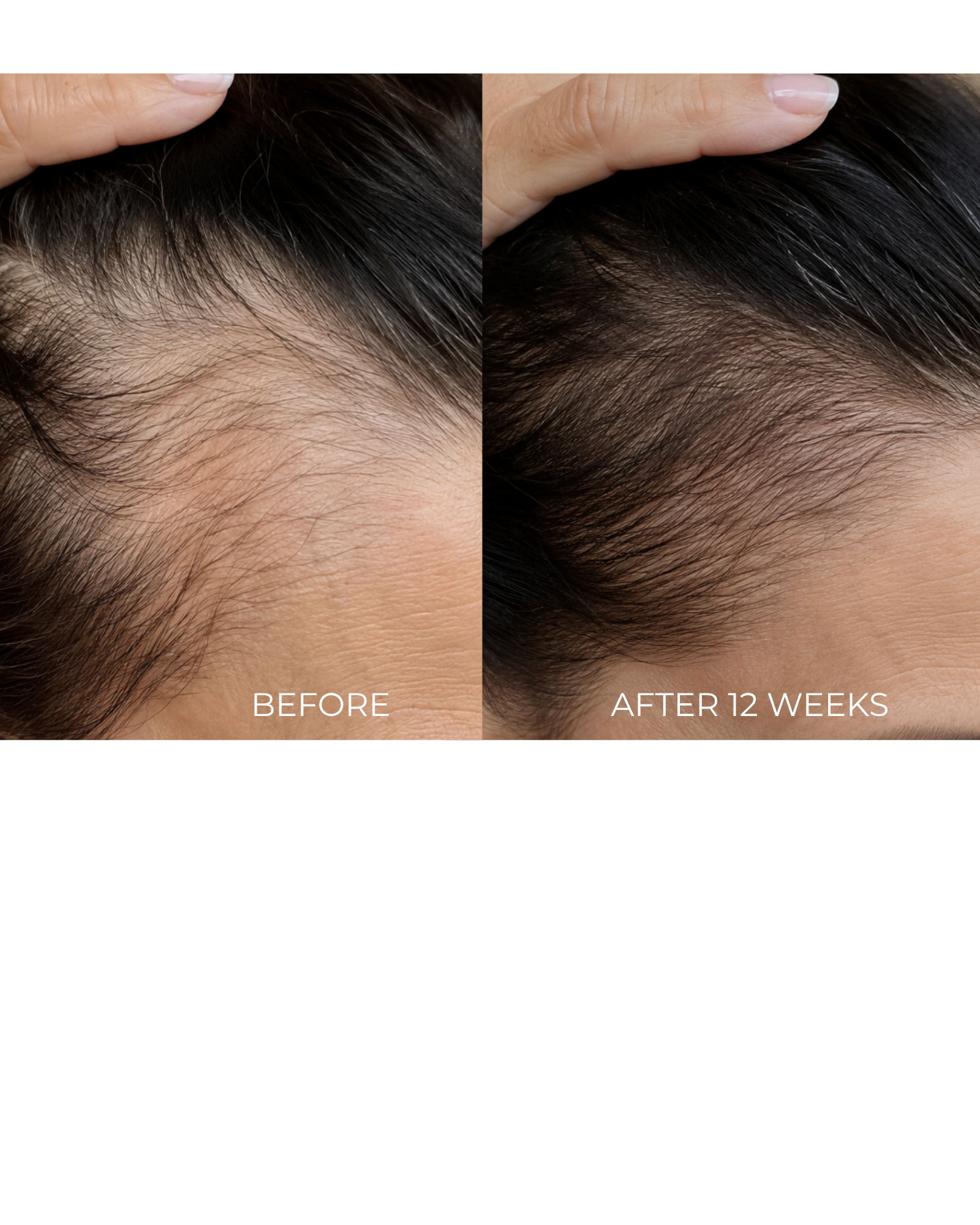
Formulated to support the scalp environment and promote the appearance of fuller, healthier hair.


Results after 12 weeks with AHK Peptide Hair & Scalp Serum | Individual results may vary.


AHK-Cu has been studied for its influence on living human hair follicles and dermal papilla cells, the specialized cells involved in regulating follicle growth.
The range associated with increased follicle elongation and dermal papilla-cell proliferation.
A statistically significant response reported in isolated human follicles.
A reduction observed in a marker associated with programmed cell death in cultured dermal papilla cells.
A reduction observed in another apoptosis-associated marker in cultured dermal papilla cells.
Supported elongation of living human follicles maintained outside the body.
Stimulated proliferation of cultured human dermal papilla cells.
Shifted several measured markers toward a more cell-survival-favorable profile.
Supports the rationale for a follicle-focused signaling treatment.
Results were observed in isolated human hair follicles and cultured dermal papilla cells. The study did not evaluate the finished AHK Hair & Scalp Serum, establish a human hair-growth percentage, or measure topical consumer results.
Pyo HK, Yoo HG, Won CH, et al. The effect of tripeptide-copper complex on human hair growth in vitro. Archives of Pharmacal Research. 2007;30(7):834–839. PMID: 17703734.