



Alchemy 21/12 · Hair + Scalp
AHK PEPTIDE HAIR & SCALP SERUM
Copper peptide scalp serum for fuller-looking hair and stronger-looking roots.
A lightweight, water-thin leave-in scalp serum built around AHK-Cu, Acetyl Tetrapeptide-3, Biotinoyl Tripeptide-1, caffeine, niacinamide, panthenol, and amino acids. Designed to support a healthier-looking scalp, fuller-looking density, and stronger-looking roots without oils, heaviness, or sticky residue.
Uses the same Alchemy 21/12 product, inventory, pricing, and checkout as the main product listing.
Product details
Finish: refreshed, balanced, non-greasy
Fragrance: none
Product material: UV-coated glass
Storage: refrigeration is highly recommended
Vegan: yes
Developed to Made Safe standards: yes
Size: 1 fl oz / 30 mL
How to use
Ingredients
Jen's note
Biotech treatment for the scalp
Not an oil. A scalp treatment.
A water-light copper peptide scalp serum designed to support the appearance of fuller, stronger-looking hair while keeping the scalp comfortable enough for consistent daily use.
Signal
AHK-Cu
Supports the appearance of a healthy scalp environment and stronger-looking hair at the root.
Anchor
Acetyl Tetrapeptide-3
Included to support the look of stronger, better-supported hair at the root.
Strengthen
Biotinoyl Tripeptide-1
Supports fuller-looking density and the appearance of stronger hair.
Support
Caffeine + Niacinamide
Help support scalp condition, comfort, and the appearance of more resilient hair.
The formulation behind the percentage
More is a number. Formulation is the strategy.
AHK-Cu concentration matters. It is not the only thing that matters. We built this serum around peptide signaling, copper coordination, scalp support, delivery, and daily consistency rather than treating one percentage as a potency score.
What actually makes an AHK-Cu serum well formulated?
Comparing scalp serums by the percentage of a single peptide leaves out most of the formula. A finished copper-peptide treatment should be evaluated by the peptide system, copper environment, supporting ingredients, vehicle, and whether the product is practical enough to use consistently.
| What to evaluate | AHK Peptide Hair + Scalp Serum |
|---|---|
| Primary copper peptide | 0.25% AHK-Cu, selected deliberately rather than maximized for label percentage. |
| Peptide architecture | AHK-Cu + 2% Acetyl Tetrapeptide-3 + 2% Biotinoyl Tripeptide-1, creating a multi-peptide system rather than relying on one active alone. |
| Copper coordination | L-Histidine is included in a near-equimolar relationship to copper as part of the coordination environment surrounding the copper peptide. |
| Scalp support | Niacinamide, panthenol, caffeine, allantoin, serine, glycine and NMF-related humectants support scalp condition and consistent leave-in use. |
| Delivery matrix | Lightweight aqueous, NMF-based leave-in system designed for direct application to the scalp. |
| Daily-use profile | Water-light and lipid-free, without the oily coating that can make daily scalp treatment difficult to maintain. |
| Hormonal actives | None. No minoxidil and no hormonal actives. |
The concentration of one active can tell you how much is in the bottle. It cannot, by itself, tell you how intelligently the finished bottle was formulated.
Why 0.25% AHK-Cu?
Because the published AHK-Cu dose response is not a simple straight line where increasing concentration continuously increases the measured response.
In the foundational 2007 human-hair-follicle study, AHK-Cu significantly stimulated follicle elongation across lower experimental molar concentrations. At higher concentrations, the measured effect changed direction.
The response observed in the study was concentration-dependent and non-linear. That is why we do not treat finished-product percentage as a simple potency score.
What this study does not prove
A concentration applied directly to an isolated human follicle in laboratory culture cannot be converted directly into the percentage that should be placed in a topical scalp serum. Skin, follicular delivery, diffusion, vehicle, frequency of use, and other formulation variables sit between the bottle and the biological target.
So the study does not prove that 0.25% is a universal optimal topical concentration. It also does not establish that a 1%, 3%, or higher finished serum is more effective simply because it contains more AHK-Cu.
Our conclusion is narrower, and more useful: the published evidence does not justify assuming that a larger AHK-Cu percentage automatically creates a better-performing finished serum.
Primary research: Pyo HK et al. The effect of tripeptide-copper complex on human hair growth in vitro. Archives of Pharmacal Research. 2007;30(7):834–839. PMID 17703734. DOI 10.1007/BF02978833
Copper deserves more thought than “more.”
Copper is an essential trace element and a biologically active metal ion. We believe that makes copper-peptide formulation a place for precision, not an ingredient arms race.
Our question was not simply, “How much AHK-Cu can we put in the bottle?” We also considered the chemical environment surrounding that copper peptide.
AHK-Cu is formulated at 0.25% alongside L-Histidine, used in a near-equimolar relationship to copper as part of the formula's coordination strategy.
Why L-Histidine?
The foundational peptide-copper patent specifically describes histidine as a suitable secondary chelating ligand and describes a preferred peptide:copper:chelating-agent relationship of approximately 1:1:1 molar for ternary peptide-copper complexes.
That is why histidine is not in this formula merely as another amino acid for the ingredient list. It was selected deliberately as part of the environment surrounding the copper peptide.
Anyone can put more AHK-Cu in a bottle. The harder question is whether the science gave them a reason to.
We do not claim that higher-concentration AHK-Cu products are inherently unsafe or ineffective. There is not adequate finished-product dose-ranging evidence to make that conclusion. Our position is simpler: the largest percentage should not automatically win the comparison.
Formulation reference: foundational peptide-copper patent describing histidine and peptide:copper:secondary-ligand complexes. US6017888A
AHK-Cu, concentration + formula questions.
What is AHK-Cu?
AHK-Cu is a copper-binding tripeptide used in scalp and hair-care formulations. In AHK Peptide Hair + Scalp Serum, it serves as the central copper peptide within a broader multi-peptide and scalp-support system.
Why does Alchemy use 0.25% AHK-Cu?
Because we do not believe the effectiveness of a finished copper-peptide serum can be judged by the percentage of one ingredient alone.
The foundational human-hair-follicle research showed a non-linear dose response: lower experimental molar concentrations stimulated follicle elongation, while higher tested concentrations significantly inhibited it. That does not establish 0.25% as a universal optimal topical dose, but it does challenge the assumption that more AHK-Cu automatically means more effect.
Is a 1%, 3%, or higher AHK-Cu serum automatically stronger or more effective?
It contains more AHK-Cu. That is not the same thing as demonstrating greater finished-formula effectiveness.
There is no published head-to-head human scalp study establishing that a 1%, 3%, or higher finished AHK-Cu serum produces better results than a 0.25% finished serum simply because of concentration.
Does the 2007 AHK-Cu study prove that 0.25% is the ideal concentration?
No. The study exposed human follicles and cultured dermal papilla cells directly to known molar concentrations. A leave-on scalp formula must first move through the skin and follicular environment.
The research establishes that AHK-Cu has biological relevance to the follicle model and that its measured response was not simply linear. It does not establish a single clinically validated finished-serum percentage.
Why does the formula contain L-Histidine?
Because copper coordination was considered as part of the formulation. The foundational peptide-copper patent describes histidine as a suitable secondary ligand and discusses an approximately 1:1:1 peptide:copper:chelating-agent relationship for ternary complexes.
Alchemy therefore uses L-Histidine deliberately in a near-equimolar relationship to copper rather than treating AHK-Cu as an isolated percentage dropped into a base formula.
Why does responsible copper formulation matter?
Copper is an essential trace element and a biologically active metal ion. Our formulation philosophy is purposeful copper use rather than maximum copper use.
We consider peptide concentration, coordination chemistry, compatible ingredients, the vehicle and repeat topical use together.
Why use three peptides instead of simply adding more AHK-Cu?
Because the peptides occupy different formulation roles. AHK-Cu is the copper-peptide centerpiece, while Acetyl Tetrapeptide-3 and Biotinoyl Tripeptide-1 provide complementary cosmetic hair-support functions.
We prefer a broader, deliberately constructed peptide system over assuming that increasing one ingredient indefinitely improves the finished formula.
What other peptides are in the serum?
The formula combines 0.25% AHK-Cu with 2% Acetyl Tetrapeptide-3 and 2% Biotinoyl Tripeptide-1.
Is AHK-Cu the same thing as GHK-Cu?
No. AHK-Cu and GHK-Cu are different copper-binding tripeptides with different amino-acid sequences. Alchemy uses them in different products and for different formulation goals.
Does AHK Peptide Hair + Scalp Serum contain minoxidil?
No. This is a cosmetic peptide scalp serum and contains no minoxidil.
Does it contain hormonal actives or DHT blockers?
No. The formula contains no hormonal actives and is not formulated as a DHT-blocking treatment.
What supports the scalp besides the peptides?
The peptide system is supported by niacinamide, panthenol, caffeine, allantoin, amino acids and NMF-related humectants selected to help maintain a comfortable, well-conditioned scalp environment for consistent leave-in use.
Will the serum make my roots oily?
The serum is intentionally water-light and lipid-free. It is designed for direct scalp application with a low-residue finish so daily use does not require changing your normal wash schedule.
How should I compare AHK-Cu scalp serums?
Look beyond the largest percentage on the label.
Consider which copper peptide is used, the disclosed concentration, the evidence supporting that concentration, copper-coordination chemistry, complementary peptides, scalp-support ingredients, delivery vehicle, daily-use practicality, hormonal actives, and whether the brand clearly distinguishes finished-product percentage from concentrations used in laboratory research.
Designed for daily consistency
Targeted where it matters.
The formula is built for direct scalp application, fast absorption, and a clean finish that does not require changing your wash schedule.
Fuller-looking density
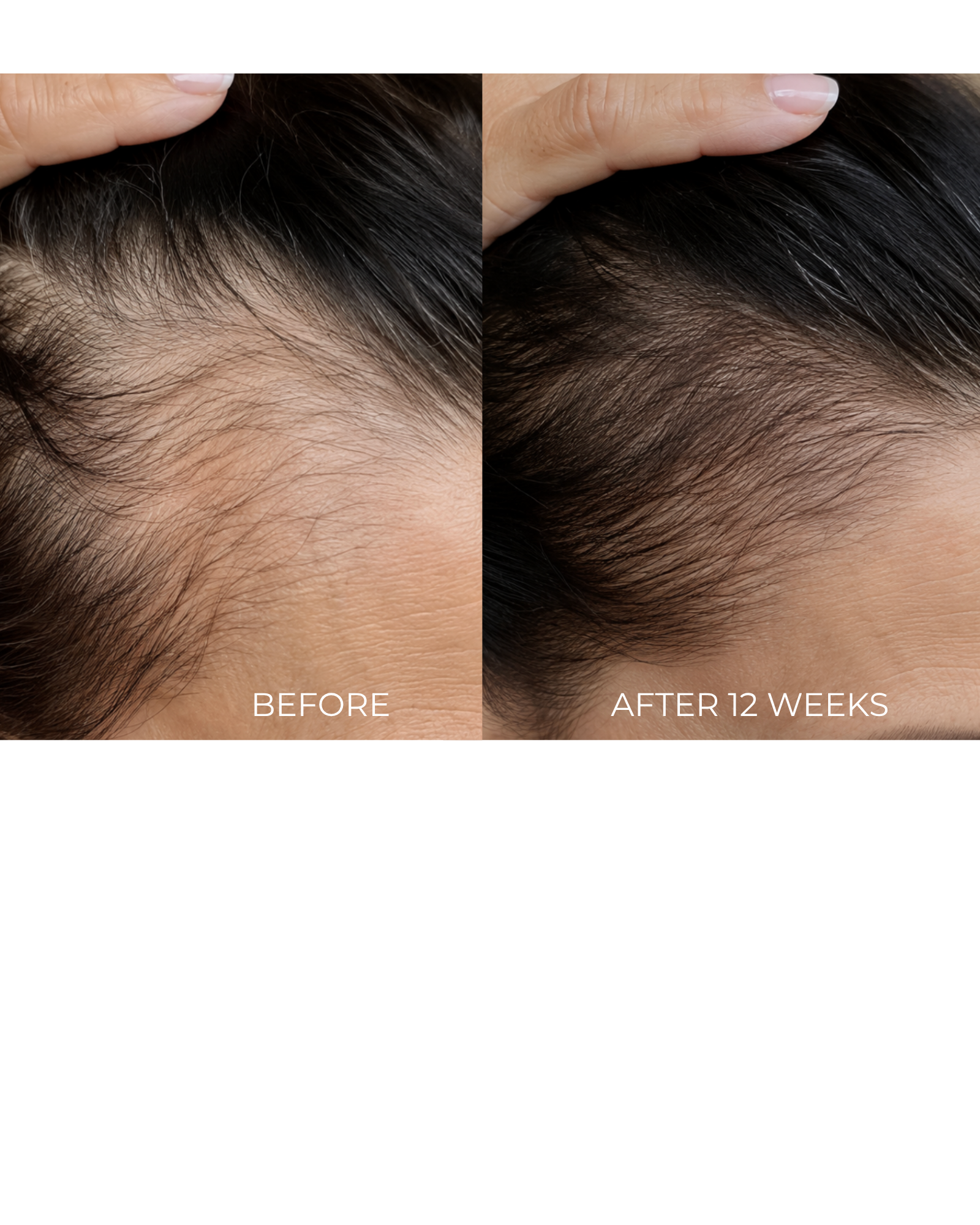
Supports the appearance of fuller, healthier-looking hair with consistent cosmetic use.
Stronger-looking roots
Designed to improve the overall appearance of the root area without fibers, oils, or coating the hair.
Healthier-looking scalp
Niacinamide, panthenol, allantoin, amino acids, and humectants help keep the scalp conditioned and comfortable.
Lightweight leave-in finish
Water-thin, fast-absorbing, and intentionally low-residue so daily use does not interfere with styling.
Loved by our beauty community
What customers notice.
“The fuller-looking finish took consistency. My part began looking less stark after regular nightly use, and the change is easiest to see in photos under the same overhead light.”
“The root area looks stronger after four weeks of regular use. My hair appears better supported around the part and front hairline, and the serum stays low-residue enough to use consistently.”
“Watery means working in small sections. A few drops at a time gives me control, and I love that the serum leaves almost no residue and does not interfere with styling.”
Start at the root.
AHK Peptide Hair + Scalp Serum combines targeted peptides, caffeine, niacinamide, panthenol, amino acids, and a water-light delivery system for daily scalp support without the oily finish.